
Why Your Digital Transformation is Stalling
DIGITAL TRANSFORMATION
Pheakdey Heng
1/24/20262 min read
Many leaders I've talked to are frustrated. They’ve invested millions into the latest cloud platforms, AI tools, and data lakes, yet the needle isn't moving. They feel like they’re running on a high-tech treadmill—lots of movement, but they’re not actually going anywhere.
The reality is sobering: most digital transformations don’t deliver. We’re seeing a massive gap between the "digital dream" sold in brochures and the messy reality of implementation. At OrraData, we’ve learned that the breakdown rarely happens because the code is bad; it happens because the human and strategic foundations are cracked.
Here is why these projects are failing and what I believe we need to do differently.
The "Tech-First" Trap
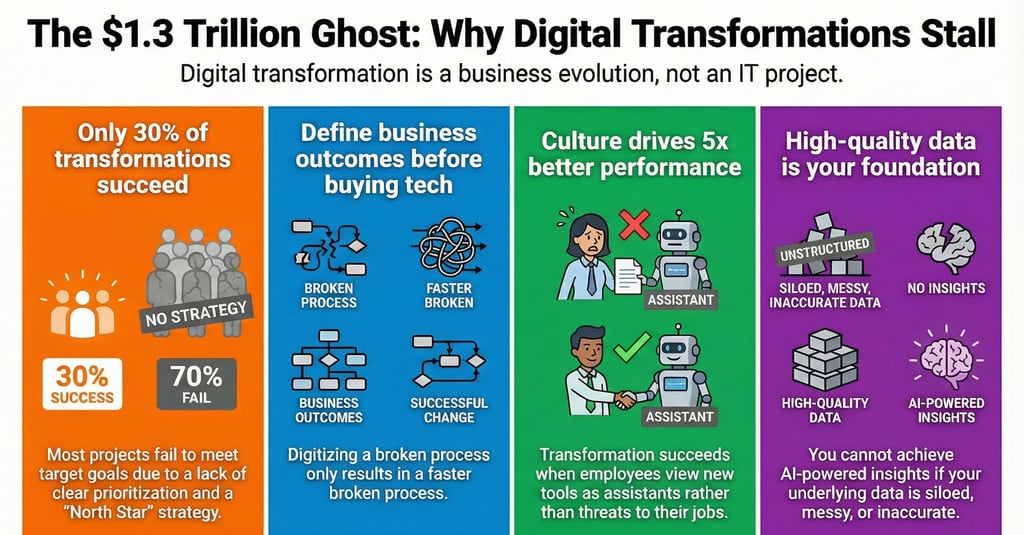
Many organizations treat digital transformation as an IT project rather than a business evolution. They buy the "shiny new toy" first and try to find a problem for it to solve later. When you lead with technology, you’re just automating old, inefficient ways of working.
In my experience, if you digitize a broken process, you just get a faster broken process. Success requires defining the business outcome first, then finding the tech that enables it.
"Digital transformation is not about technology. It is about leadership, strategy, and a new way of thinking." — George Westerman, MIT Sloan Principal Research Scientist (Westerman, 2014).
The Culture Chasm
You can buy software, but you can’t buy adoption. According to research by Boston Consulting Group (BCG), companies that focus on culture are five times more likely to achieve breakthrough performance than those that neglect it (BCG, 2021).
I see this constantly: leadership announces a big change, but the people on the front lines feel threatened or overwhelmed. If your team views a new data tool as a "surveillance mechanism" or a "job replacer" instead of an assistant, they will quietly sabotage it. Transformation lives or dies in the breakroom, not the boardroom.
Lacking a "North Star" Strategy
A common reason for failure is "pilot purgatory"—where companies launch dozens of small initiatives that never scale. This happens when there is no cohesive strategy linking these projects to the bottom line.
McKinsey & Company notes that only about 30% of digital transformations succeed in meeting their target goals (McKinsey, 2023). Most of the failures stem from a lack of clear prioritization. If everything is a priority, nothing is. As a CEO, I’ve found that it’s better to do three things that transform the business than thirty things that just update it.
The Data Quality Paradox
We talk a lot about "Data-Driven Decisions," but you can’t drive anywhere if your fuel is contaminated. Many transformation projects hit a wall because the underlying data is siloed, messy, or inaccurate.
Organizations often underestimate the "unsexy" work of data cleansing. They want the AI-powered insights today, but they haven't fixed the spreadsheets from five years ago. Without a foundation of high-quality, accessible data, your digital house is built on sand.
A Forward-Looking Thought
Digital transformation isn't a destination you reach; it's a capability you build. The projects that fail are the ones that treated "digital" as a checklist item to be completed. The ones that succeed are the ones that use technology to become more human—more responsive to customers, more empowering for employees, and more agile in the face of change.
The question I leave you with is this: Is your organization buying technology to change, or are you changing so you can finally use technology?