
Why Digital Transformation Is No Longer Optional
DIGITAL TRANSFORMATION
Pheakdey Heng
1/2/20263 min read
Every day at OrraData, I talk to leaders who feel like they are running a race with no finish line. They’ve moved to the cloud, they’ve automated their marketing, and they’ve built fancy dashboards. Yet, many still ask me: "When does the 'transformation' part end?"
The truth is, it doesn't. We are currently witnessing a massive shift in the global market where digital transformation is moving from a "project" to the very fabric of how a business breathes. If you feel like the ground is moving beneath your feet, you’re right—the global market for these technologies is exploding, and the stakes have never been higher.
The Trillion-Dollar Shift
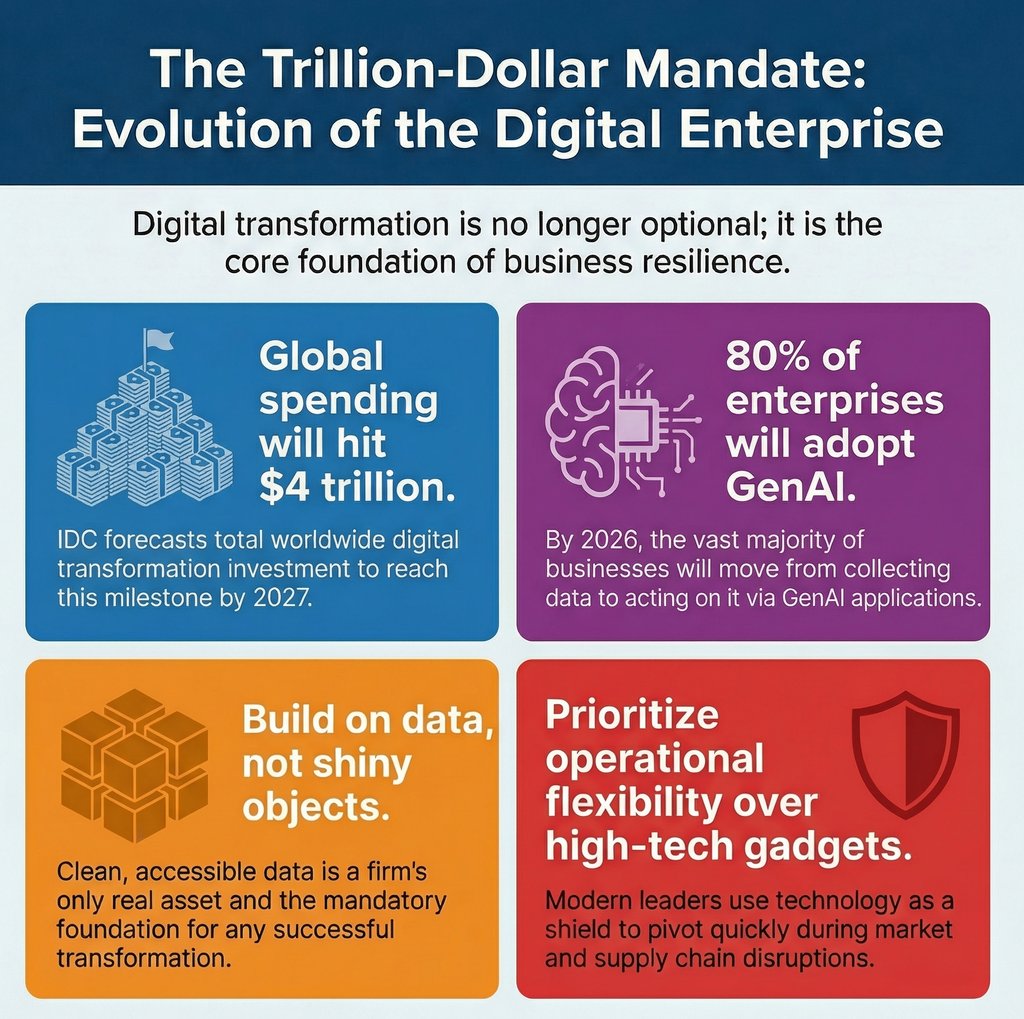
The numbers coming out of major research firms are, quite frankly, staggering. We aren't just talking about a few billion dollars in software updates anymore. According to the International Data Corporation (IDC), worldwide spending on digital transformation is forecast to reach nearly $4 trillion by 2027 (IDC, 2024).
This tells me that companies are no longer just "trying out" new tech. They are betting their entire future on it. At OrraData, we see this as a maturation of the market. It’s not about buying the newest gadget; it’s about deep-rooted structural changes to survive a volatile economy.
AI is the New Engine, Not Just a Turbocharger
While we’ve been talking about digital transformation for a decade, Artificial Intelligence has fundamentally rewritten the playbook. It’s the primary driver behind this market growth. Gartner predicts that by 2026, over 80% of enterprises will have used GenAI APIs or deployed GenAI-enabled applications (Gartner, 2023).
I find this fascinating because it shifts the focus from "collecting data" to "acting on data." For years, companies sat on mountains of information they couldn't use. Now, AI is the tool that finally lets them move the needle.
"Generative AI is not just a technology or a business tool. It’s a shift in the way we interact with information, and eventually, it will change how we interact with the world." — Jensen Huang, CEO of NVIDIA (as cited in various industry analyses).
The Transition from 'Digital' to 'Data-First'
In my view, the "Global Digital Transformation Market" is actually a bit of a misnomer. It should be called the "Data Sovereignty and Insight Market." You can have the best cloud infrastructure in the world, but if your data is messy, your transformation will fail.
Statista projects that the global digital transformation market will grow to over $1.5 trillion by 2030 (Statista, 2023). A huge chunk of that investment is going into data management and analytics. You cannot build a skyscraper on a foundation of sand, and businesses are finally realizing that clean, accessible data is their only real asset.
Operational Resilience Over Shiny Objects
One of the most important takeaways from current market trends is the move toward "operational resilience." In a world of supply chain disruptions and geopolitical shifts, transformation is being used as a shield.
Forrester highlights that businesses are now prioritizing "adaptive" strategies—using technology to pivot quickly when the market changes (Forrester, 2024). This is a shift I advocate for daily at OrraData. It’s not about being the most high-tech company; it’s about being the most flexible one.
As we look toward 2028 and beyond, the gap between the "digital haves" and "digital have-nots" is widening into a canyon. The global market figures suggest that the leaders of tomorrow are those investing today in systems that learn and adapt.
I’ll leave you with one thought: If your digital strategy were stripped away tomorrow, would your business have a nervous system left to function, or is your "transformation" just skin deep?
References
Gartner (2023). Gartner Top 10 Strategic Technology Trends for 2024.
IDC (2024). Worldwide Digital Transformation Spending Guide, 2023–2027.
Statista (2023). Digital transformation market size worldwide from 2023 to 2030.
Forrester (2024). Predictions 2024: The Year Of Generative AI Realism.