
The Hidden Cost of Legacy Data Systems
DIGITAL TRANSFORMATION
Pheakdey Heng
12/12/20252 min read
Most leadership teams look at their annual IT budget and see a predictable line item for "maintenance." It feels like a necessary cost of doing business—the price you pay to keep the lights on. But there is a much larger, quieter expense that doesn’t show up on a balance sheet: the opportunity cost of staying tethered to legacy data systems.
When your data is trapped in rigid, outdated architectures, you aren’t just paying for upkeep; you’re paying for the inability to move fast. Here is why the "hidden" costs of legacy systems are often more expensive than a total digital overhaul.
The innovation tax
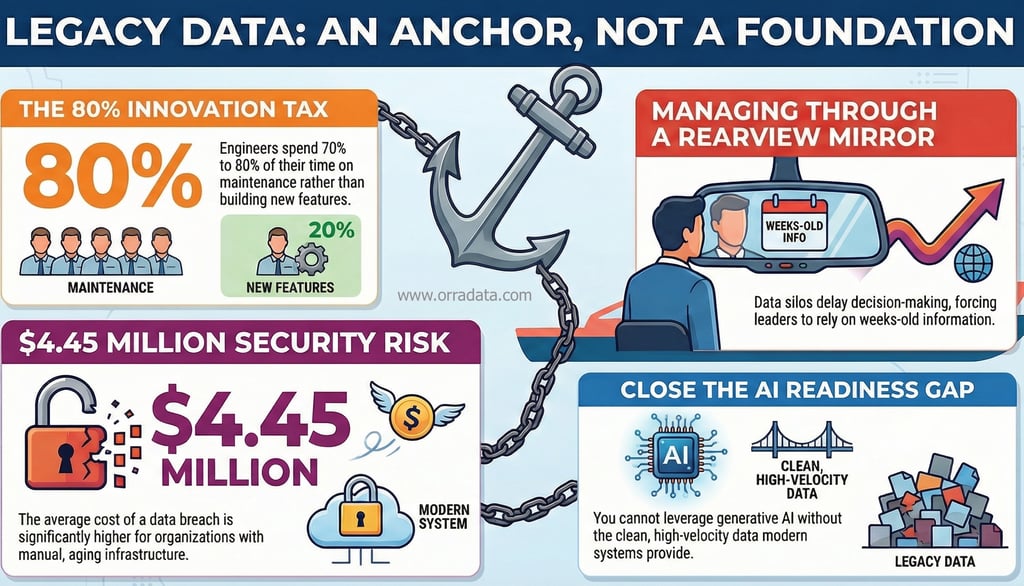
Every time your team wants to launch a new initiative or experiment with AI, legacy systems demand a "tax." Instead of building new features, your engineers spend 70% to 80% of their time just trying to make new tools talk to old databases.
This isn't just a technical hurdle; it’s a morale killer. Top-tier talent wants to work with modern stacks, not spend their careers building "middleware" bridges for software written two decades ago. When your infrastructure is brittle, "innovation" becomes a buzzword rather than a daily practice.
Data silos and the "version of truth" problem
In older systems, data is often trapped in departmental silos. Marketing has their numbers, Finance has theirs, and Sales has a third version. Reconciling these different views requires manual intervention, which introduces human error and massive delays.
The cost here is the speed of decision-making. If it takes your team two weeks to aggregate data for a report, you are always managing your business through a rearview mirror. Modern systems allow for a "single source of truth," ensuring that when a decision needs to be made, everyone is looking at the same real-time reality.
"Legacy systems are not just a technical debt; they are a strategic liability that prevents organizations from reacting to market changes in real-time." — Gartner (2023)
The rising price of "good enough" security
Legacy systems were often built before the modern cybersecurity threat landscape existed. Patching these systems is like putting a new deadbolt on a cardboard door. As hackers become more sophisticated, the cost of securing outdated infrastructure rises exponentially.
According to IBM’s 2023 report, the average cost of a data breach has reached $4.45 million. Organizations with modern, automated security frameworks often see significantly lower costs and faster recovery times than those relying on manual processes and aging software.
Missing the AI window
You cannot bolt generative AI onto a fractured, messy data foundation. AI requires clean, accessible, and high-velocity data. Organizations still running on legacy systems find themselves in a "data readiness" gap. While competitors are using machine learning to predict customer churn or optimize supply chains, legacy-bound companies are still struggling with basic data ingestion.
The hidden cost here is market share. In a world where data is the primary competitive advantage, being "slow to data" is the same as being "slow to market."
Upgrading your data infrastructure is rarely about the technology itself—it’s about reclaiming your company’s agility. The most expensive path you can take is the one that keeps you standing still while the rest of the world accelerates.
If you look at your current systems, are they a foundation you can build on, or an anchor holding you in place?