
Stop Adding Tech and Start Thinking Digital First
DIGITAL TRANSFORMATION
Pheakdey Heng
1/8/20262 min read
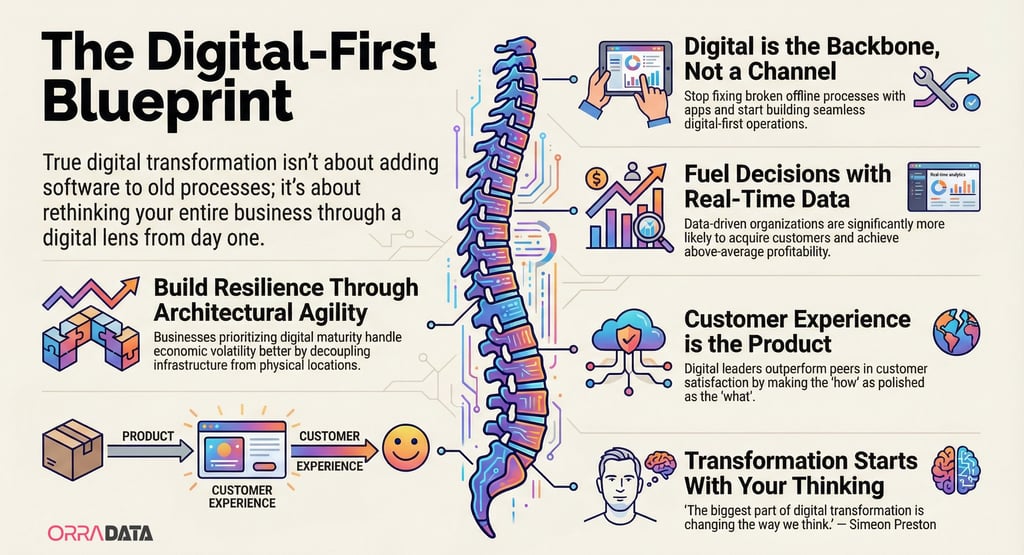
For a long time, the standard approach to business growth was to build a physical foundation and then "sprinkle" some technology on top to make things faster. We called it digital transformation. But lately, I’ve noticed a shift. The companies that are actually thriving aren't just moving their old processes to the cloud; they are rethinking their entire existence through a digital lens from day one.
If you feel like you’re constantly playing catch-up with the latest tools, it’s likely because your strategy is digital-added, not digital-first. Here is why making that distinction matters for the future of your business.
Digital-first is a mindset, not a tech stack
Being digital-first doesn't mean you have the most expensive software; it means you assume digital is the primary way your customers will interact with you. In a traditional model, digital is a "channel." In a digital-first model, digital is the backbone. When you start here, you stop trying to fix broken offline processes with apps and start building processes that were meant to be seamless from the start.
I find this interesting because it removes the friction we’ve all grown used to. When your internal operations and your customer experience are designed digitally from the ground up, you don't just work faster—you work differently.
Data becomes an asset, not just a byproduct
In a traditional setup, data is something you collect in a spreadsheet and look at once a month. In a digital-first strategy, data is the fuel for every decision. McKinsey research highlights that data-driven organizations are significantly more likely to acquire customers and achieve above-average profitability (McKinsey & Company, 2023).
When your business is built digitally, you aren't guessing what your customers want. You have the telemetry to see it in real-time. This shift from "I think" to "I know" is what separates the leaders from the laggards in today's market.
Resilience is built into the architecture
We’ve seen how quickly the world can change. Companies with a digital-first approach don't break when the physical world hits a snag; they pivot. Because their infrastructure is decoupled from physical locations or manual paperwork, they can scale up or down almost instantly. According to Gartner, businesses that prioritize digital maturity are far better equipped to handle economic volatility (Gartner, 2024).
"The biggest part of digital transformation is changing the way we think." — Simeon Preston
This quote hits home for me. Resilience isn't just about having a backup server; it’s about having a culture that isn't tethered to "the way we've always done it."
The customer experience becomes the product
Today, people don't just buy what you sell; they buy how easy it is to deal with you. A digital-first strategy ensures that the "how" is as polished as the "what." Whether it's an automated onboarding flow or a self-service portal, the goal is to respect the customer's time.
If your digital experience is an afterthought, your customers will feel it. But when it’s the priority, you create a level of loyalty that a traditional "sales-first" approach simply can't match. Harvard Business Review notes that digital leaders consistently outperform their peers in customer satisfaction scores (HBR, 2023).
The transition to a digital-first strategy isn't something that happens over a weekend. It’s a deliberate choice to stop viewing technology as a utility and start viewing it as the environment in which your business lives. As we look toward the next few years, the gap between the "digitally native" and the "digitally hesitant" will only widen.
Ask yourself: If you were starting your company today, from scratch, with no legacy systems or old habits—how would you design it? That answer is your roadmap.