Making Sense of Automation, Digitalization, and Transformation
DIGITAL TRANSFORMATION
Pheakdey Heng
12/3/20252 min read
We’ve all been in meetings where these three terms are tossed around like they’re interchangeable. Someone suggests automating a spreadsheet, and suddenly the conversation drifts into "our digital transformation strategy."
But here is the reality: treating these concepts as the same thing is one of the quickest ways to waste a budget. It’s like confusing a faster engine with a completely new way of traveling. To lead effectively, we need to know exactly which lever we are pulling.
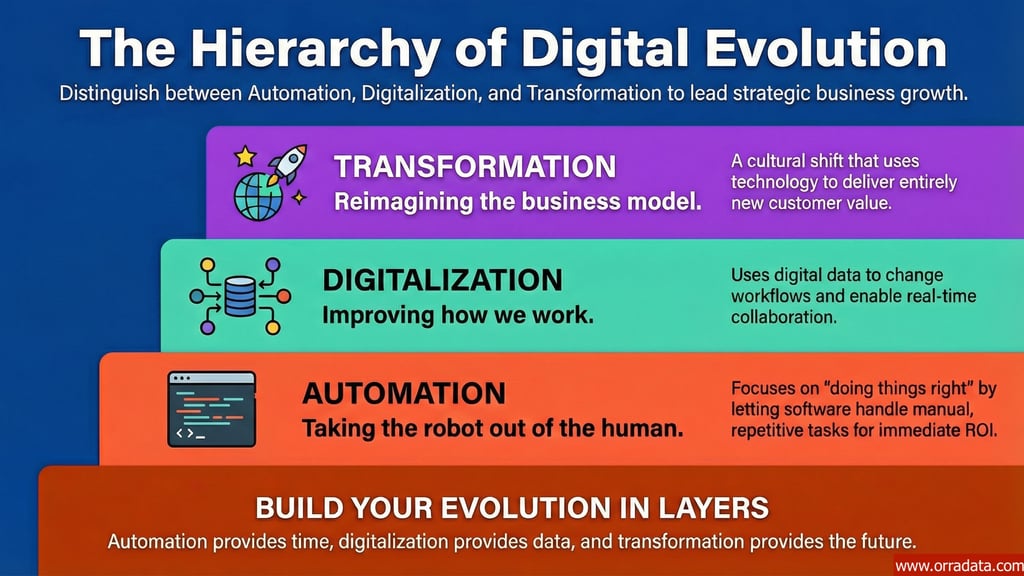
Automation: Taking the Robot Out of the Human
Automation is the most straightforward of the three. It’s about taking a manual, repetitive task and letting software handle it. If you have a person copying data from an email into a CRM every morning, and you install a script to do it instead, you’ve automated a task.
The goal here isn't to change the business model; it’s simply to gain efficiency and reduce human error. It’s about "doing things right." In my experience, this is the best place to start because the ROI is immediate. You aren't rethinking the "why" yet; you’re just making the "how" faster.
"The first rule of any technology used in a business is that automation applied to an efficient operation will magnify the efficiency. The second is that automation applied to an inefficient operation will magnify the inefficiency." — Bill Gates (Forbes)
Digitalization: Changing How We Work
Digitalization is a step up. This isn't just about making a task faster; it’s about using digital data to change how a process actually functions.
Think about the shift from paper records to a cloud-based project management system. You aren't just "automating" the paper; you are creating a digital environment where team members can collaborate in real-time from different continents. This changes the workflow itself. It moves the needle from "doing things right" to "doing the right things" by using data to improve the way people interact with their work.
Digital Transformation: A Fundamental Business Shift
This is the big one, and it’s the most misunderstood. Digital transformation isn't a project with a start and end date. It’s a cultural and strategic shift that often results in an entirely new business model.
While automation and digitalization are about improving existing processes, transformation is about the customer. It’s asking: "How can we use technology to deliver value in a way that wasn't possible five years ago?" It requires a mindset where you are willing to abandon "the way we’ve always done it" in favor of a digital-first approach. It’s less about the software you buy and more about the agility of the organization you lead.
"Digital transformation is not about technology at all. It’s about the transformation of the business strategy and the organization." — Harvard Business Review
Why the Distinction Matters
If you try to "transform" before you’ve "automated," you’ll likely find your team overwhelmed by complexity. Conversely, if you only focus on "automation," you’ll eventually be disrupted by a competitor who used technology to rethink the entire customer experience.
At OrraData, we see these as layers. Automation provides the time, digitalization provides the data, and transformation provides the future. The question isn't which one you need—it’s knowing which stage of the journey you are currently in.
As you look at your roadmap for the next quarter, ask yourself: are we just making an old process faster, or are we actually building something new?