
Data-Driven Culture: Myth vs. Reality
DIGITAL TRANSFORMATION
Pheakdey Heng
12/22/20252 min read
We’ve all seen the flashy presentations. A company buys a top-tier analytics platform, hires a team of PhDs, and announces that they are now "data-driven." But a few months later, the dashboard lights are green while the business results stay red. Decisions are still being made based on the loudest voice in the room or a "gut feeling" that contradicts the numbers.
The truth is that most organizations are drowning in data but starving for insights. We often mistake technology for culture, and that is where the disconnect begins.
The culture gap is a people problem, not a tech problem
For years, the narrative has been that if you build the right infrastructure, the insights will follow. The reality is much harsher. Year after year, surveys of top executives show that the biggest barrier to data success isn't the software—it's the people.
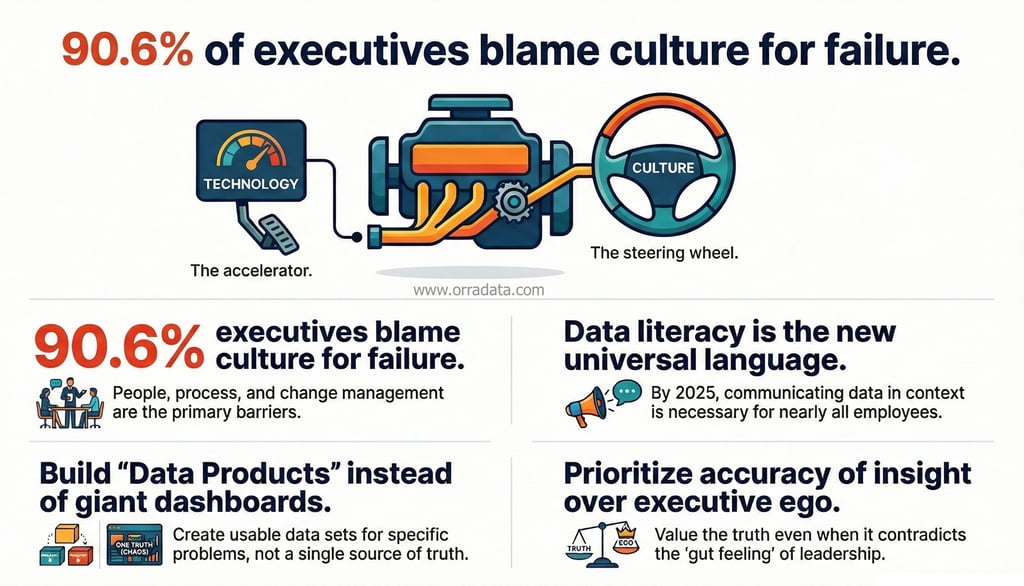
According to the Wavestone (formerly NewVantage Partners) 2024 Data and AI Leadership Executive Survey, a staggering 90.6% of executives identify culture—process, people, and organizational change—as the greatest barrier to becoming data-driven (Wavestone, 2024). This tells me that we are spending millions on tools while neglecting the human element of how decisions actually get made.
"The hardest part of a data-driven transformation is the cultural change... It is not a technology challenge. It is a people challenge." — Randy Bean, Harvard Business Review (Bean, 2021).
Data literacy is the missing language
I often see a massive gap between the data scientists who build models and the managers who are supposed to use them. If your team doesn't understand how to read, work with, or argue with data, they will revert to intuition every time.
Gartner defines data literacy as the ability to communicate data in context. Without this "shared language," data remains a siloed asset. Research suggests that by 2025, data literacy will become an explicit and necessary skill for nearly all employees (Gartner, 2021). It’s not about making everyone a math expert; it’s about making everyone comfortable enough to ask, "What does the data actually say about this?"
The myth of the "Single Source of Truth"
We chase the "Single Source of Truth" like it’s the Holy Grail. In reality, different departments need different views of the world. Marketing cares about attribution; Finance cares about cash flow. The myth is that one giant dashboard will solve everyone's problems.
The reality is that data-driven cultures thrive on governance and trust rather than just centralization. McKinsey notes that companies that successfully scale their data efforts are those that focus on "data products"—creating specific, usable data sets for specific business problems rather than trying to boil the ocean (McKinsey, 2022).
Short-term pressure vs. long-term insight
In many boardrooms, the pressure for quarterly results kills the patience required for data-driven experimentation. Data often tells us we need to change course or that a favorite project isn't working. That is an uncomfortable reality.
A true data-driven culture allows for failure. It values the accuracy of the insight over the ego of the executive. If your culture punishes "bad" data results, your people will eventually stop showing you the truth and start showing you what you want to see.
Moving from the myth to the reality of a data-driven culture requires us to stop looking at screens and start looking at how our teams interact. Technology is just the accelerator; your culture is the steering wheel. Without a clear direction and a team that knows how to drive, the fastest engine in the world won't get you where you need to go.
If the data proved your most successful strategy was actually failing, would your culture allow you to stop doing it today?